

My family’s journey to the camp began in 1991, when Burma’s military launched an exclusionary operation known as Operation Pyi Thaya, or ‘Clean and Beautiful Nation’. They crossed into Bangladesh as refugees. In 1993, under an agreement involving UNHCR, Bangladesh and Burma, now known as Myanmar, a process called ‘Operation Hope’ promised protection and voluntary repatriation. More than three decades later, that hope remains unfulfilled. I am Forid Alam and this is my story.
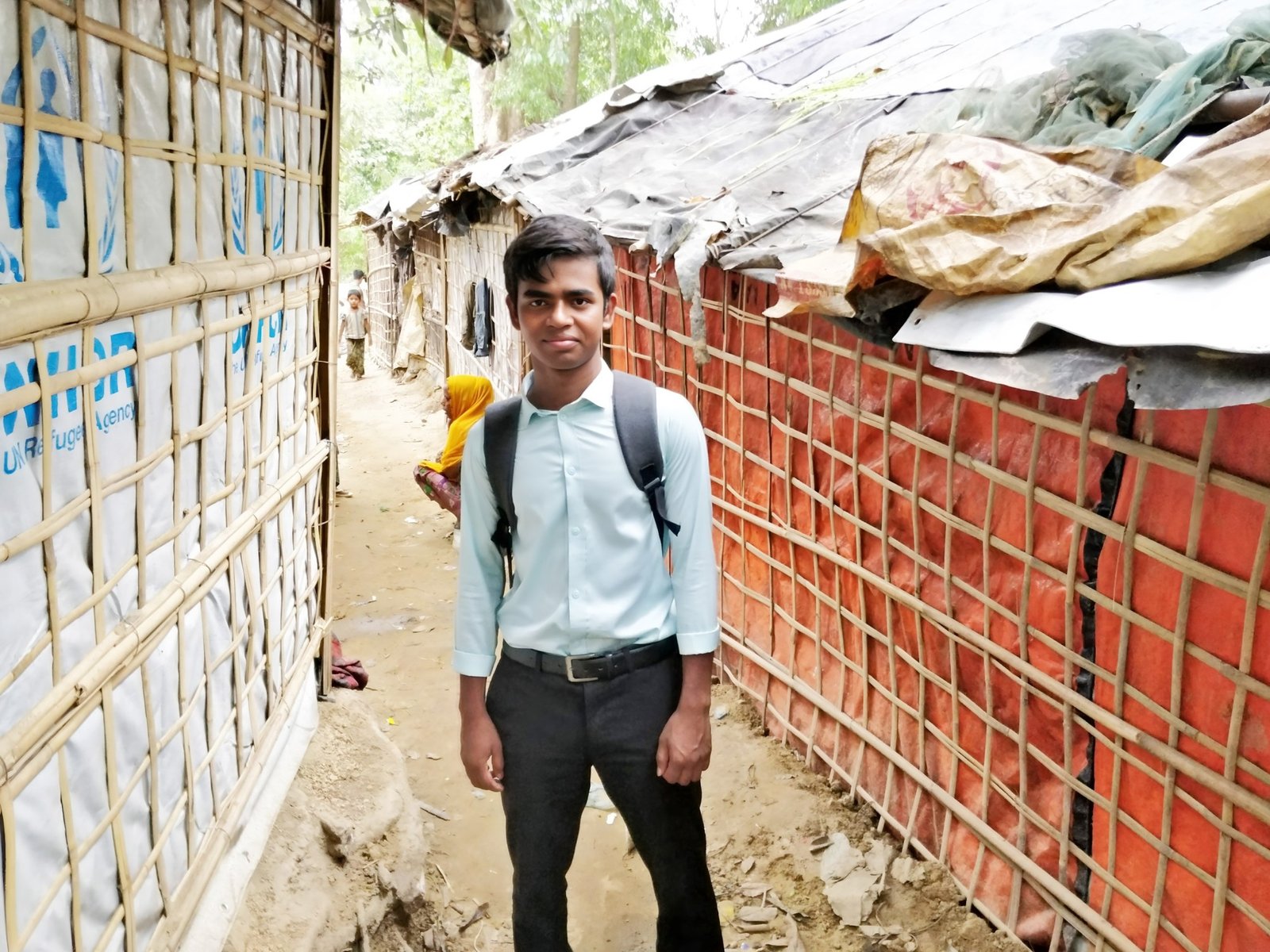
Forid Alam, born in Kutupalong refugee camp in Bangladesh, where he continues to live as part of a generation growing up in long-term displacement and statelessness.
I was born a refugee in Kutupalong camp in Bangladesh in December 1998. The camp became my first sky, my first road, my first prison. I inherited confinement. I was born into a refugee-hood that for my parents has lasted more than three decades. My story is of a people trapped between survival and rejection, between memory and uncertainty.
People often call the camps ‘shelters’, but it is an open-air prison in its true sense. The fences may not always be made of unbreakable iron, but they exist in every part of our lives. We have been denied freedom of movement and expression, proper education, livelihood, dignity, equal treatment and, for many families, unity itself.
We grew up watching roads that we could see but could not walk. The outside world felt physically close yet unreachable. A refugee born in the camp can spend decades living within a few kilometres of land without ever experiencing freedom. Restriction became normalised, as if movement itself were a privilege rather than a human right. Checkpoints, surveillance and the threat of arrest shaped ordinary life. A Rohingya asking for rights was often treated as ungrateful; one demanding justice could be seen as dangerous.
The camps themselves were overcrowded and suffocating. Families of six, eight, sometimes ten people lived in tiny 12-by-10-foot shelters made from bamboo, tarpaulin and mud. During monsoon seasons rainwater entered homes and destroyed belongings. In summer, the heat became unbearable. Fires regularly turned entire blocks into ashes within hours.
 Camp residents gather around a tube well for water and daily washing. Shared facilities and overcrowding are part of everyday life in Kutupalong.
Education was one of the cruellest forms of deprivation. For decades, formal education was heavily restricted. We were allowed only limited learning up to primary, often without recognised curricula, proper certificates, or opportunities for higher studies. A refugee child could dream of becoming a doctor, engineer, teacher, or writer, but the system reminded us every day that such dreams were not meant for us. Those of us who tried to study beyond the permitted limits had to do so secretly, sometimes by hiding our identity within the host community.
I remember studying under difficult conditions, fighting against the darkness of refugee-hood, hiding my identity, studying with few books, little electricity and almost no opportunity. Yet education became our resistance. Many Rohingya students studied in secret like me, borrowed books from others, and taught younger children voluntarily inside the camps, even though such efforts were often discouraged or restricted. We believed that knowledge was the only thing the fences could not fully imprison.