For the Sun After Long Nights, by Nilo Tabrizy and Fatemeh Jamalpour, tells the story of life under Iran’s Islamic Republic, especially for women and minority communities. Published by Atlantic Books, it is reviewed here by Shahin Bekhradnia.
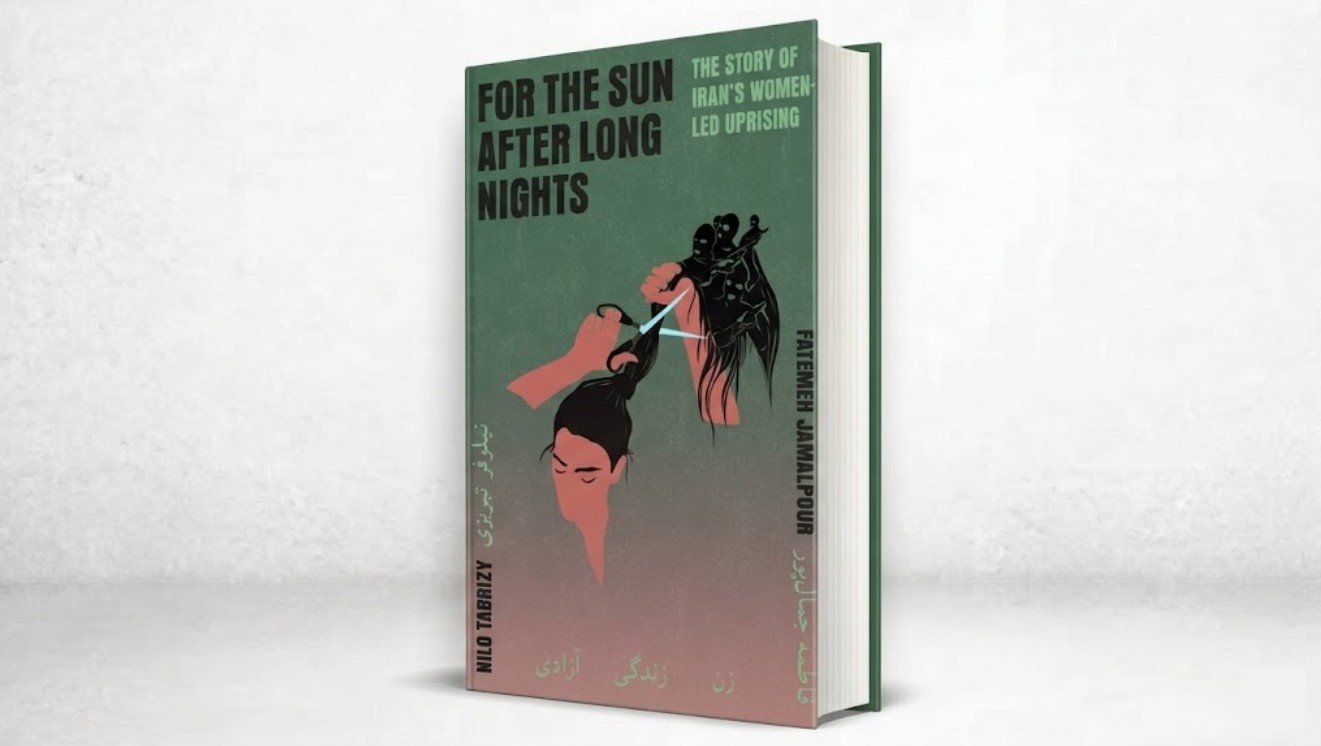
For the Sun After Long Nights by Nilo Tabrizy and Fatemeh Jamalpour explores life under Iran's Islamic Republic through personal testimony, historical reflection and the experiences of women, journalists and minority communities.
This 250-page book is a painful read, meticulously detailing recent events in Iran. Written by two young journalists born after the 1979 Islamic revolution, it was prompted by the protests that followed the death of Mahsa (Jina) Amini in September 2022. Amini, a young Kurdish woman, died in police custody after being arrested for allegedly failing to wear the mandatory hijab correctly.
Once the book contract was confirmed, Fatemeh, who was based inside Iran and had gathered material through interviews with eyewitnesses, was advised by her lawyer to leave the country. Nilo, raised in Canada and working for The New York Times, used open-source intelligence techniques to verify video footage. The book’s claims are carefully sourced, as the extensive endnotes show.
 Authors Fatemeh Jamalpour and Nilo Tabrizy combined eyewitness reporting, personal experience and open-source investigations to document the protests and their aftermath.
Some readers may find the structure confusing. Chapters alternate between the two authors, interlacing personal memory with national history and culture. Poetry is central: from Ferdowsi, the great Persian poet, to Baraye, the protest song that became an anthem after 2022. The reader waits 78 pages before reaching the 1953 coup against Mohammad Mossadegh, the Shah’s reforms and the opposition that brought Ayatollah Khomeini to power.
 The death of Mahsa (Jina) Amini in September 2022 sparked nationwide protests that evolved into one of the most significant challenges to Iran's Islamic Republic in decades. Photo: Reuters
Only here can one perhaps glean a hint of regret that the many advances won for women under the previous regime under the Shah were needlessly lost. Meanwhile we read about the range of abuses to which journalists and victims’ families were subjected following protests in 2009, 2017 and 2019. The death of Mahsa Amini garnered even more demonstrations, defiance and opposition and was met with increasing ruthlessness.
Bludgeoning, rape, threats to family members for speaking out – leading to some going into exile – withholding of corpses to prevent burials, desecration of graves, internet denial, the use of ambulances to transport protesters to prisons in place of their legitimate functions, all feature time and again as individual cases are discussed. One particular aspect which is emphasised throughout the book is the apparent disproportionate targeting of ethnic groups who, like others throughout Iran, had their reasons to vent their frustrations on the streets. Baluchis, Bakhtiaris and Kurds are among the groups who have suffered significantly more brutal suppressions.
 A protester burns a hijab and chants slogans outside Iran's consulate in Istanbul following the death of Mahsa (Jina) Amini. The image captures the defiance that fuelled the women-led protest movement chronicled in For the Sun After Long Nights. Photo: The Hill
Fatemeh, born into a strict Islamic family with strong Bakhtiari tribal ties, lived in the south of Iran. An independently minded young woman, she wanted to break free of the constraints she had experienced and reached Tehran where her reporting career took off. After a run-in with the authorities for reporting protests against the economic difficulties in Mashhad in 2017 and 2020, she obtained a position in London with the BBC but having won a prize for her journalism felt her potential was unappreciated. While there she made around 20 TV packages exposing widespread poverty, prostitution, drug addiction, the extravagant budgets devoted to supporting proxy overseas forces, malnutrition in prisons, and the downing of a Ukrainian airliner by Iranian missiles. After only a year, she returned to Iran to look after her father, ill from cancer. On arrival in Tehran, and over the coming weeks, she was subjected to interrogations on suspicion of disloyalty. The book vividly and distressingly describes the interrogation techniques.
On almost every page some act or event is described as so brutal and inhuman that one wonders how or what can bring this Kafkaesque situation to an end. And yet there is irony in this. In 2025 when the book was published, we sensed real optimism that the protests against the hijab were finally succeeding. Sadly, that optimism was short lived. The even greater irony is that Trump’s war has produced a regime, ever more defiant and hard-line. Today few people dare go out onto the streets, not least because the forces representing law and order seem to have carte blanche to do whatever they like, and no one can stand in their way. It is estimated that tens of thousands of demonstrators were massacred within 48 hours in January 2026, with thousands more imprisoned, and with executions at an all-time high. For now, the callous ruthlessness of the regime appears to have cowed the protests – especially as protests will be characterised as unpatriotic or even pro-American.
As if to alleviate some of the relentless accounts of abuse, Nilo describes her sense of longing for an Iran she barely knew, having spent her life in Vancouver where her father relocated his family. She nostalgically recalls her first childhood romance which took place during a trip to Iran as a 10-year-old child; and the sweet memories of her adventures in the strange atmosphere soon after the Iran-Iraq war are evocatively related. Her close affinity to her typically Persian strong family ties, and her sense of dislocation and alienation led to her childhood unhappiness and confused sense of identity – accentuated from 2017 when she started reporting on Iranian politics, and realised that she could not return to connect with her homeland – a realisation that has had a profound impact on her.
 Evin Prison in Tehran, where many political prisoners featured in For the Sun After Long Nights endured imprisonment, interrogation and intimidation while continuing to resist in small but meaningful ways. Photo: Reuters
Anyone who begins this book unaware of the scale of abuse in Iran, or uncertain whether reports have been exaggerated, is unlikely to finish it with doubts. Its conclusion pays tribute to women political prisoners in Evin Prison, where even amid humiliation, executions, lashings and sexual abuse, prisoners find ways to defy the system: putting on make-up, cooking, creating small gardens and making hand-crafted objects. This is a sad but necessary book, and a testament to the courage and suffering of ordinary Iranians.