Last month Democracy Asia reported on population decline in India and China. Rahul Jaywant Bhise finds a starker version of the same story in Singapore, Asia's richest economy and the country with the world's most extreme shortage of children. He asks whether the real fix lies in immigration rather than incentives.
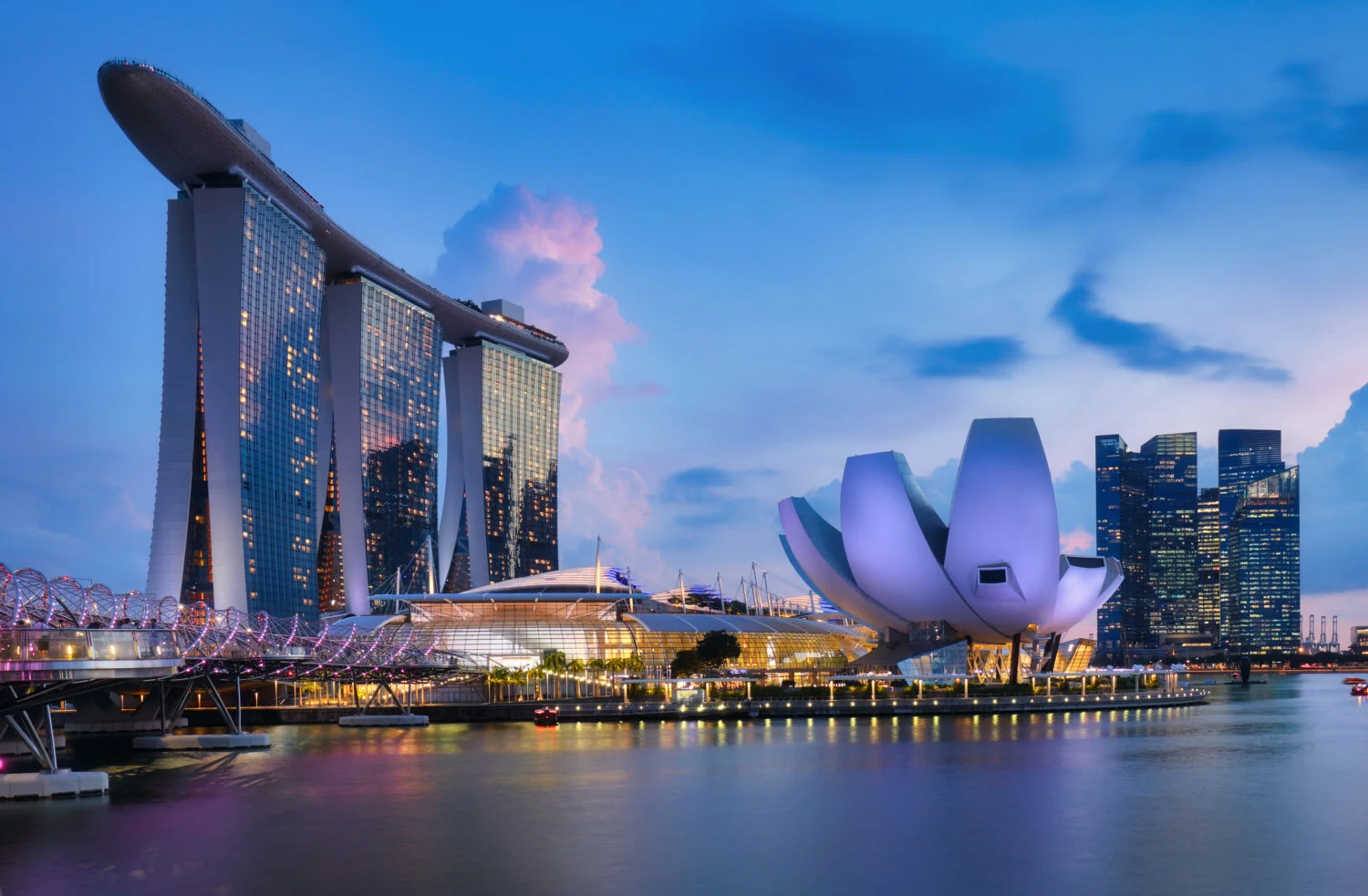
Marina Bay, Singapore, a symbol of the city-state’s extraordinary economic transformation and wealth, amid a deepening demographic crisis marked by record-low fertility. Photo: The CFO
Last month Democracy Asia reported on population decline in India and China. Rahul Jaywant Bhise finds a starker version of the same story in Singapore, Asia's richest economy and the country with the world's most extreme shortage of children. He asks whether the real fix lies in immigration rather than incentives.
Singapore's skyline of gravity-defying towers, rooftop gardens and a container port humming around the clock is the visible face of one of the world's most remarkable economic transformations. Six decades ago a resource-poor trading post with no natural hinterland, the city-state now has a nominal GDP per capita of around US$108,000, putting it among the ten richest countries on Earth and comfortably the wealthiest in Asia – ahead of Hong Kong, Japan, South Korea and Qatar. It is Asia's leading financial centre, and by most measures one of the best-run states in the world.
Yet all that wealth has bought Singapore almost nothing when it comes to persuading its own citizens to have children. Last year the country's total fertility rate – the average number of children a woman can expect to have across her reproductive years – fell to a record 0.87. South Korea at 0.80 is lower. Fertility rate needs to reach 2.1 simply to hold the population steady.
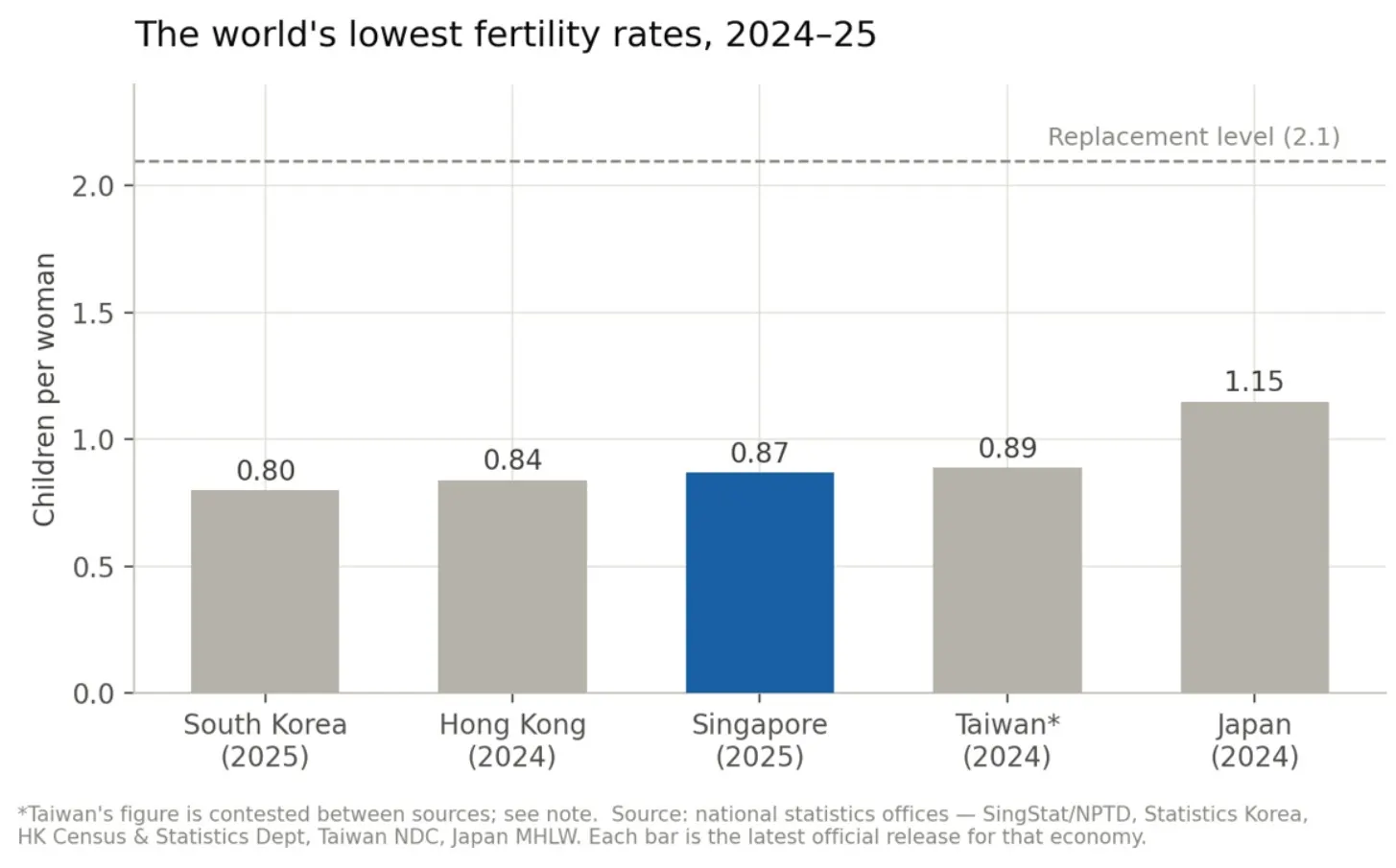
Prime Minister Lawrence Wong used Singapore's National Day Rally on 23 August to announce the country's biggest reset of family policy in a generation. A new Child Support Package will give every Singaporean citizen child S$70,000, or close to US$55,000, in support from birth to age seventeen. Roughly US$48,800 of that is new direct payment, on top of existing baby grants running since 2001.
This is not Singapore's first attempt to engineer how many children its citizens have. It is the first time it has tried to reverse one. From 1966, the ‘Stop at Two’ campaign discouraged births with a precision rarely matched anywhere: maternity leave pay was withdrawn after a second child; hospital fees rose for a third; school-place priority went to children whose parents had been sterilised before forty; and sterilisation itself came with paid leave attached. Procedures peaked above 10,000 a year in 1976, nine in ten performed on women. The policy worked. Fertility reached the 2.1 replacement rate by 1975. It then fell away, to 1.82 by 1977 and 1.4 by 1986. The anti-natalist machinery stayed largely in place for twelve years after the government's own target had been met.
When Singapore finally reversed course in 1987, the slogan changed to ‘Have Three or More, if You Can Afford It’. It was aimed pointedly at educated Singaporeans whom then prime minister Lee Kuan Yew worried openly were marrying and reproducing too little.
What followed was nearly four decades of increasingly generous incentive. The Baby Bonus launched in 2001 and expanded repeatedly; a Large Families Scheme added further grants for a third child; childcare subsidies, parental leave and housing priority schemes multiplied. None of it worked as intended. Fertility fell from 1.4 to 0.97 in 2024 and 0.87 in 2025. Forty years of a state trying to talk its citizens back into large families has been outrun by the twenty years it spent successfully talking them out of it.
The new package tries to address a criticism levelled at every previous version: lump-sum baby bonuses reward the decision to have a child rather than the eighteen years of raising one. Payments now run to age seventeen regardless of birth order; childcare leave nearly doubles to twelve days a year; government-supported childcare fees are due to fall to around S$150, or US$115, a month by 2030. The package also raised the income ceiling for Build-To-Order flats, from S$14,000 to S$16,000 a month, or around US$11,000 to US$12,600.
That detail deserves more attention than it has had. Singapore's marriage and parenthood timeline is not set mainly by salary or sentiment; it is set by the public housing pipeline. Build-To-Order flats typically take three to five years to complete from application, and priority balloting for a first flat is explicitly tied to marital and parental status. A couple's decision to marry is, in a literal sense, gated by a state waiting list before anything else. Raising the income ceiling widens who can apply; it does nothing to shorten the wait. If housing timing is the binding constraint on family formation, a package built mostly around cash transfers is treating a symptom while leaving the actual bottleneck, the flat itself, largely untouched.
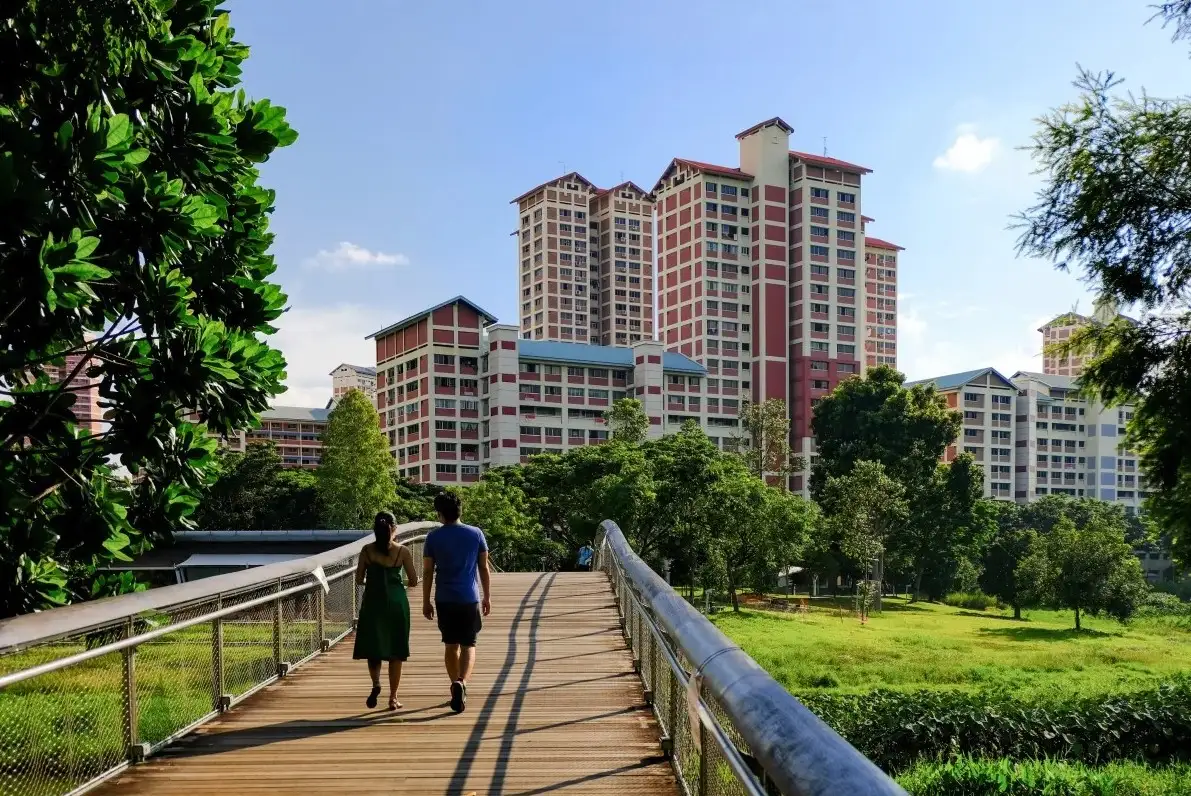 A couple walks past Singapore’s HDB public housing, where
access to and timing of a home can influence decisions about
marriage and starting a family. Photo: Shutterstock
A couple walks past Singapore’s HDB public housing, where
access to and timing of a home can influence decisions about
marriage and starting a family. Photo: Shutterstock
The angle Singapore's politics has avoided over a decade is immigration. In 2013, a White Paper projected the country's population could reach 6.9 million by 2030, sustained by 15,000 to 25,000 new citizens a year – acknowledging falling births would be offset by naturalisation. The paper triggered the largest public protest Singapore had seen in years.
The population crossed six million only in 2024 and has now reached 6.11 million, with 1.91 million ‘non-residents’, almost a third of everyone living in Singapore. Ministers repeatedly told parliament the total will stay ‘significantly below’ 6.9 million. What that studied vagueness obscures is that for two decades Singapore's population has grown mainly through immigration, not birth, even as its pro-natal messaging continues to speak as though the birth rate is still the main lever being pulled.
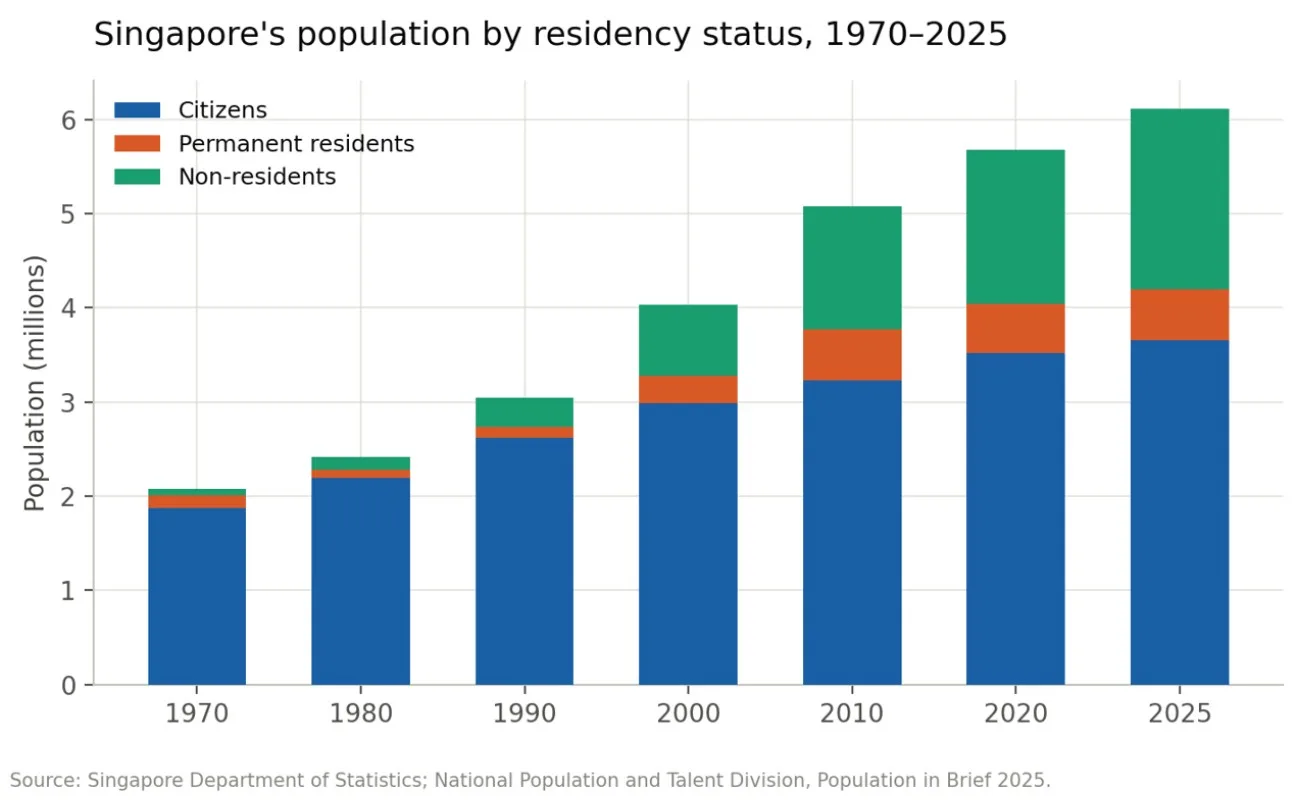
The citizen band has barely doubled since 1970; the non-resident band has grown more than thirtyfold.
Wong himself framed the new package as more than a cheque. ‘We want to make a fundamental shift in how we support families,’ he told the rally, adding that the state would ‘walk alongside parents throughout the journey of raising their children.’ It is a warmer register than 1987's ‘if you can afford it’, and far warmer than 1976's sterilisation call. Whether warmth changes the arithmetic is the open question.
That scepticism already shows up in the polling. A survey released this year found one in four Singaporeans do not plan to have children at all, and its own surveys have long found career pressure, the cost of raising children and long working hours to be the reasons cited most often, well ahead of the size of any grant. Associated Press recently put a face to that scepticism: a 34-year-old Singaporean man, speaking anonymously, explained that a second child would upend a lifestyle he and his wife have grown to value, from travel to eating out. It is a calculation no Child Credit is designed to answer. Demographers argue that once a society settles into a small-family norm, cash transfers shift stated intentions more easily than completed births – a pattern as visible in Tokyo and Seoul as in Singapore's ownOfficially, Singapore still says it has no population target. Unofficially, it has needed one since at least 2013, and has met it mostly through the immigration counter rather than the maternity ward. A government that once suppressed its birth rate with such administrative precision that it took twelve years to notice the policy had overshot is unlikely, five decades on, to be able to buy it back with cheques of any size. If Singapore's technocrats cannot solve this with the same toolkit that has solved nearly every other problem the country has faced, the more useful question may not be how much more to spend, but whether family policy was ever really the plan — or whether immigration always was, and pro-natalism was simply the story told about it.